Home User Manual Discussion Forum Search

Bridge - eClinicalWorks

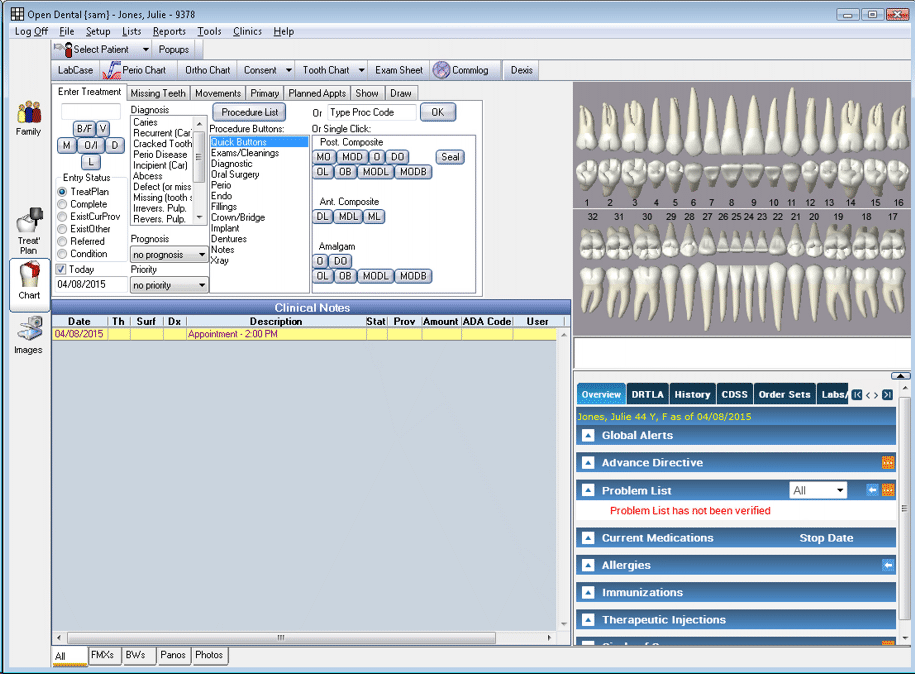
eClinicalWorks is a leading medical practice management software.  Open Dental (OD) can provide dental capabilities for eClinicalWorks (eCW) customers. 

There is a demo video available at eCW_Demo.wmv

There are two different bridging modes:

Tight Integration
All practice management functions are handled in eClinicalWorks, including patient selection, accounts, and appointments. Open Dental is only used for clinical charting.  All bills are sent from eClinicalWorks.  All medications are tracked in eClinicalWorks.  The only way to access a patient in Open Dental is to first open that patient in eClinicalWorks, and then click on a link which takes you to the same patient in Open Dental.  Open Dental gets closed to transfer the user back to eClinicalWorks.  As procedures are completed in Open Dental, they are passed to eClinicalWorks for billing.

Standalone
Open Dental runs as an entirely separate program.  Any patients that are added or changed in eClinicalWorks are automatically synched in Open Dental.  The patients would receive entirely separate bills for dental procedures.  Medications would have to be entered again into Open Dental.  Any Rx written in Open Dental would have to be manually copied to the medical chart if it needs to be seen there.  The user would have to log in twice, once for eCW and once for OD.  Users should make changes to demographics in eCW rather than in OD, because their changes might otherwise be overwritten later by the synch process.  There must be a primary key used to uniquely identify patients in both systems.  Because Open Dental users do not have any control over the PatNum, the ChartNumber is instead used.  As patients are added or changed in eCW, Open Dental will attempt to fill in the ChartNumber field of existing patients to match the internal patient ID from eCW.  Once the ChartNumber field has been set in OD, it allows straightforward future synchronization.

The simplest way to choose the bridging mode is to base it on whether you are already using Open Dental side-by-side with eClinicalWorks.  If so, then you would likely choose standalone mode.  However, if you are an existing eClinicalWorks customer and have not yet begun using Open Dental, then you would likely choose tight integration.

The choice of bridging modes must be carefully considered. Changing bridging modes later would be very complex.  For example, if switching from tight integration to standalone, then existing accounts in Open Dental would all need to be adjusted to avoid duplicate billing from both systems.  And if switching from standalone to tight integration, account balances would all need to be transfered to eClinicalWorks.  Either scenario would involve some sort of a conversion service which would need to provided by programmers from both eCW and OD and which would involve a significant fee.

If choosing standalone integration, turn on the eClinicalWorks bridge as described below, selecting Standalone.  Then follow the instructions for setting up the Open Dental HL7 application.  Finally, work with eClinicalWorks support to have eCW start sending HL7 messages to the folder.  The only messages that will be sent will be demographic messages (ADT).  If the patient does not seem to exist in OD, or the demographic information for a patient is different, then trigger an ADT message from eCW, probably by resaving the patient information in eCW.  Remember that the ChartNumber in OD will contain the PatientID from eCW.

Setup
To setup the bridge, go to Main Menu | Setup | Program Links. Double click on eClinicalWorks in the list.

If a user turns on the eCW bridge, the existing passwords for all users will stop working.  So before turning on the bridge, you must make sure that the admin password in OD is blank.  After the bridge is turned on, then you may set a password.

Check the enabled box.

Also, set the path(s) to the HL7 folders. The paths will be relative to the server computer, NOT the workstation you are on.  You will also need to go to the HL7 page and follow the instructions to install the OpenDentalHL7 service on your server. Follow the update sequence on the HL7 page carefully for all updates

If the box is checked for "Patient Fee Schedules Set Manually", then that will be done in the Family module.

Installation Path
When using eCW in tight integration mode, Open Dental must be installed to the same path on all computers in order for the bridge from eCW to work.  The current recommendation is:
C:\Open Dental\

It is also acceptable to use
C:\Program Files (x86)\Open Dental\
on all computers, keeping in mind that this path has to be typed in manually when installing to 32 bit computers.  On those computers, the x86 path will not exist and will be created during installation.

This path
C:\Program Files\Open Dental\
would seem to be a good option, but 64 bit versions of Windows will NOT allow this path to be used for a 32 bit program like Open Dental.  It's not a good choice.

Regardless of what path is chosen, assistance will be required from eCW installers to set this bridge path in eCW.

Procedures
This section only applies to the tight integration mode.  As procedures are completed in Open Dental, they will need to be sent to eClinicalWorks for billing and claim purposes.  This is the general sequence that is followed:
1. A visit is created within eCW.  This automatically creates a synched appointment in OD using HL7.  This may take around 60 seconds.
2. When user accesses OD from within eCW, the visitID/aptNum is passed silently to OD.
3. An appointment will now be present in the OD chart.
4. The user attaches procedures to this appointment in OD.
5. After attaching procedures, set the appointment complete near the beginning of the appointment to generate the default Procedure Notes.
6. During the course of the appointment, procedures may still be altered, added, removed, etc.
7. After the patient treatment is done, check the procedures one last time for accuracy.
8. Open the appointment and click the Complete button at the middle right. This sends the procedures to eCW.
9. Close Open Dental.
10. The Complete button will only be enabled if the visitID from step #2 matches the aptNum.
11. If the procedures were sent incorrectly and need to be altered, open the appointment again and press the Revise button. This allows you to fix them in OD. They will also need to be separately fixed in eCW. The user must have the Setup permission in order to revise.

Patient Demographics
All patient demographic data originates in eCW and is passed to OD. There can be no editing of patient demographic data in OD if using tight integration.  All synchronization is based on the patient ID for tight integration.  If patient demographic data is sent from eCW in tight integration mode, all data for the matching patient ID will be automatically overwritten in OD without any user interaction.  If the patient ID does not yet exist, then a new patient will be created in Open Dental.

Fee Schedule Import
In order to present accurate Treatment Plans to the patient, Fee Schedules must be present in OD.  Export the fee schedules from eCW as .csv files.  To import them into OD, go to the Procedure Codes window, and at the lower right, click the Tools button.  In Fee Schedule Tools, click the Import eCW button.  If there are procedure codes in the file that are not present in OD, such as medical codes, those fees will not be imported.  The csv file will have two columns in it with fee schedules, Unit Fee and Allowed Fee.  During import you will be able to choose which column to import.  Regardless of which column you choose, the newly created fee schedule will be a standard fee schedule in Open Dental.

Fee schedules are assigned automatically to patients using HL7 messages coming from eCW.  The assignment is done based on fee schedule name, so the names must match exactly, including capitalization and spaces.

Web Service
The Web Service feature works well with eCW integration and is particularly helpful for security for multiple location clinics where displaying the patient in Open Dental is slow due to network speed.  In the Choose Database window, check the box for Using eCW.

Technical Details
This section is for programmers and power users only.    It primarily refers to the tight integration mode.

See Command Line Arguments for information on how eCW communicates with Open Dental.

See HL7 for installation instructions and technical details.

Some bridging features that might soon be added to OD
Complete button should force user to set appointment complete first.
Finish message parsing for insurance.
Hide some menu items.
Save incoming HL7 messages in db for debugging.  Build viewer?
Notify users at various workstations if HL7 service is not running or is wrong version.


Open Dental Software 1-503-363-5432